

Giving feedback is one of the top issues that people managers worry about the most. No surprise, then, that giving feedback is either avoided or put off until it’s too late. The cost is high if not giving feedback or giving poorly thought through feedback. It impacts motivation, trust, and ultimately, the performance of your team.
Sometimes, there is the assumption that people don’t want feedback. Yet, as one study found across five experiments, there was a disconnect between the employees wanting constructive feedback and the managers avoidance of giving it. The researchers concluded that because managers focus on the anxiety and stress of giving feedback, they end up underestimating the extent to people want helpful feedback.
No surprise that a different study, in the Journal of Business Communication, found that most negative feedback is given indirectly. For example, through the famous (and ineffective), praise sandwich. You know the one, praise, quickly say the negative thing, then end with praise. This rarely, if ever, works.

If you want to be a brilliant people manager, giving timely and helpful feedback is one thing you need to learn to get comfortable with.
In this article, you’ll learn:
- Why people react in negative ways to feedback
- The benefits of giving effective feedback
- The skills that can help managers
- Seven frameworks for different feedback scenarios
Why people react in negative ways to feedback
Feedback is defined as providing specific and personalised information, based on direct observation, delivered in a thoughtful way to help people improve and achieve their potential. When the feedback is ill-timed, not thought through, not carefully crafted, and doesn’t have the aim to help, then it’s no wonder people react negatively.

Research has found that unhelpful and critical feedback from managers can significantly increase people’s feelings of shame, negative feelings, and exhaustion at the end of the workday. A series of five studies explored the way people self-regulate and defend against negative feedback, including denying, distorting, or avoiding altogether. Unsurprisingly, the more tired people became, the harder it was to self-regulate and the more likely they were to become defensive when given negative feedback. In some instances, they rejected the feedback altogether. This reinforces the importance of timing when giving feedback. You need to have the right level of energy, but so does the person you’re giving feedback to.
The benefits of giving effective feedback
Action happens (and people feel good)
A 2025 study published in the Journal of Applied Psychology found that when managers framed feedback in a performance-oriented and helping-focused way it felt less risky for them and the recipients were more likely to receive the feedback in a positive way and were more likely to act upon the feedback. In addition, emotions and feelings were more likely to be positive for both givers and recipients.

It seems that when we give effective feedback it makes us feel good, the other person feels good and more importantly, they are more likely to act and improve. This can only help boost motivation and performance.
Creativity increases
One study looked at two different feedback styles and the impact on creative performance. Informational feedback gave people constructive information about their behaviour and a clear sense of how to go about this. Competence feedback was delivered in a much controlling way, focusing on a set standard or outcome that must be achieved. People given informational feedback that was positive and gave them autonomy were more likely to go away and come up with more creative ideas.
The skills that can help managers
Empathy: According to research, people who received negative feedback from a manager showing empathy were more likely to react positively to the feedback. They also saw the manager as being more effective at giving feedback.
Open-minded: Suspending our judgement and not jumping to conclusions is one of the best things we can do when giving negative feedback. A study led by Guy Itzchakov found that people were less likely to feel anxious and defensive when feedback was given by someone perceived as non-judgmental, empathetic and an attentive listener. In turn, the recipient was far more likely to explore other ways of doing things.

Listening: Research involving more than 3,000 people found that the best managers were great listeners. People said they were more likely to feel safe and supported when a manager listened well. Managers who listened were also seen as more helpful and cooperative, and asking useful questions to move things in a positive direction.
Seven frameworks for different feedback scenarios
The BEAR framework (Harms & Roebuck, 2010)
When to use this: For giving negative feedback.
Behaviour: Specific, detailed observations of the negative, non-productive behaviour(s) observed. Use concrete language. Be clear, detailed and accurate. For example, “You have missed the last three deadlines I’ve set you to send me essential information for the project.”
Effect: Describe how the person’s behaviours/actions is/are unhelpful to the team or you. Describe feelings. For example,“I feel anxious because I’m concerned that we won’t finish the project on time. Missing deadlines also has a knock-on effect across the team. Some of the team end up having to work late or weekends to make up for it.”
Alternative: Describe the behaviour you would like to see. Offer suggestions for alternative behaviour(s). Indicate how these suggestions would improve the person’s and/or team’s performance. Give a specific time frame for change, or a specific number of occurrences. Clarification of expectation is vital here. For example, “I would like you to meet the next deadline I give you. If there is an issue and it means you’re going to miss the deadline, please tell me rather than go silent. And I’d like you to suggest an alternative deadline.”
Result: Describe the positive outcomes that will be achieved from making the change. Outline the potential consequences to the individual and/or the team if change doesn’t happen. In follow-up meetings, this section can be used to acknowledge progress that has been made. For example, “By meeting the deadline, it takes unnecessary pressure of the rest of the team and means they don’t have to work extra hours.”


The BET framework (Berry, Cadwell & Fehrmann, 1996)
When to use this: For giving positive feedback.
Behaviour: Specific, detailed observations of the positive behaviour(s) observed. Use concrete language. Be clear, detailed and accurate. For example, “At three of our four team meetings this month you put forward helpful ideas to help us improve the customer experience. Your idea about giving an upgrade or bonus with a purchase to encourage repeat custom was particularly brilliant.”
Effect: Describe how the person’s behaviours/actions is/are helpful to the team. For example, “Your regular contribution of ideas helps with the team deliver a great customer experience and supports us remaining in the upper quartile of performance in our sector.”
Thank you: Thank the person for their contribution, anchoring back to the specific behaviour/action. For example, “Thank you for regularly contributing new ideas to improve the customer experience. I really value your help.”
Some managers I’ve trained in BET like to thank people at the start and again at the end.


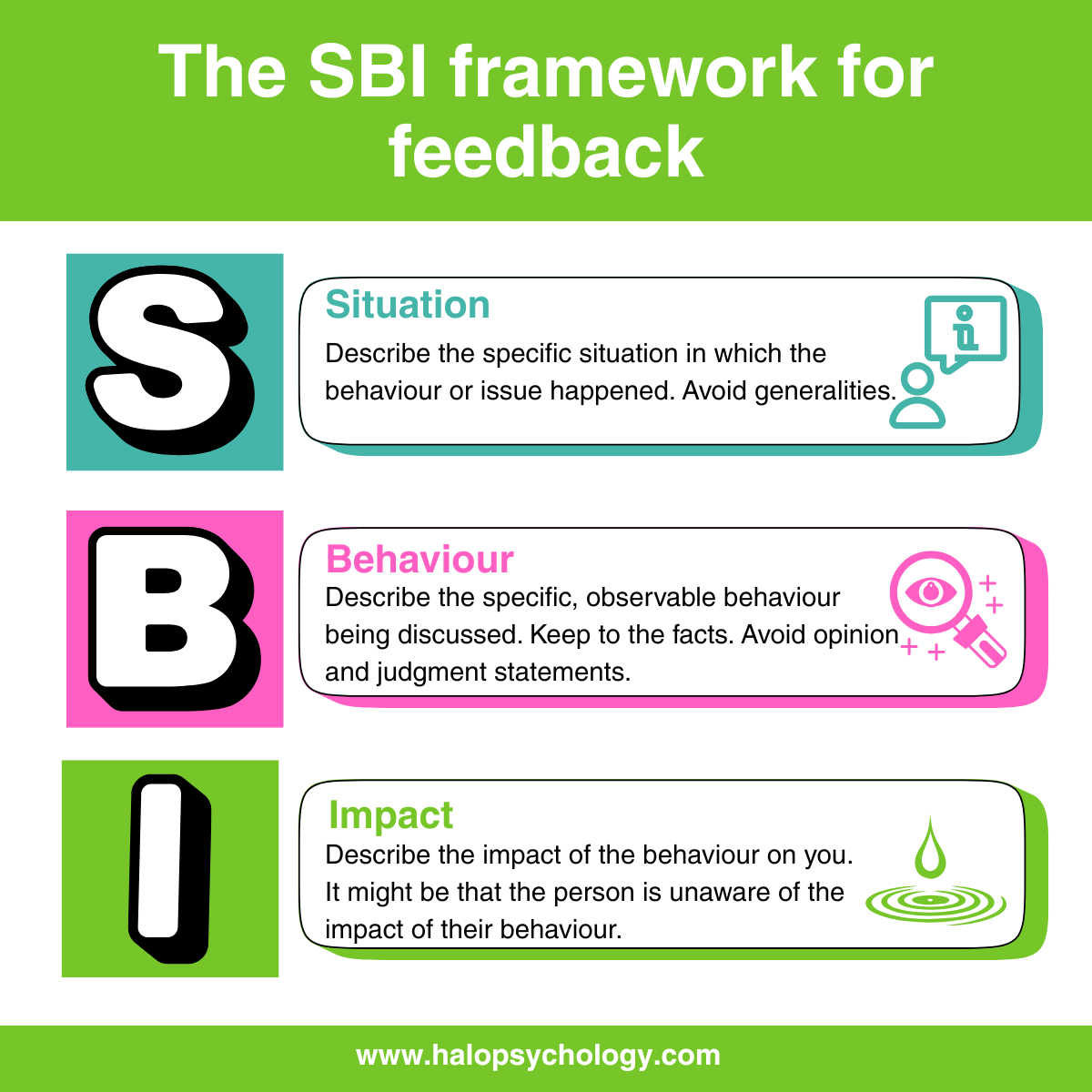
The SBI model – Situation, Behaviour, Impact (Gentry & Young, 2017)
When to use this: Use for giving either positive or negative feedback.
Situation: Describe the specific situation in which the behaviour or issue happened. Avoid generalities. For example, “At the 10.00am team meeting on Tuesday, when we were discussing project budgets…”
Behaviour: Describe the specific, observable behaviour being discussed. Keep to the facts. Avoid opinion and judgment statements. For example, “On four occasions you interrupted me when I was explaining to the team how we would change the process for project budgets.”
Impact: Describe the impact of the behaviour on you. It might be that the person is unaware of the impact of their behaviour. For example, “I felt frustrated because my train of thought kept being interrupted. I also felt anxious because the discussion about project budgets took longer and meant we were unable to get to other important agenda items in the time we had available.”

The Pendleton Method (Pendleton, Schofield, Tate & Havelock, 2003)
When to use this: When time is short. With a focused conversation being possible in 10 minutes.
Psychologist Dr David Pendleton devised five ‘rules’ to help guide feedback conversations, when training a group of Family Medicine Practitioners (FMPs) who found it difficult to give feedback. I have adapted David’s original rules, which focused on FMPs, for a more general management audience.
Step 1: Ask your team member to tell you two or three things that have gone well or they did well.
Step 2: Acknowledge what they think went well. Then share two or three things that you think have gone well or they did well.
Step 3: Ask your team member to tell you two or three things they can improve on or they could do differently.
Step 4: Acknowledge your team member’s ideas. Then share two or three areas for improvement. Next, discuss ideas and strategies for closing the gap for improvement.
Step 5: Both of you then discuss the most important points from the conversation. Ask your team member to confirm the action they will take.


SOAR model (Stavros, 1998)
When to use: If you want a feedback conversation to be transformative and create a positive energy. Useful for annual appraisal conversations.
Originating from research by Jacqueline Stavros, the SOAR model is underpinned by Appreciative Inquiry and is also inspired by the well-known SWOT analysis. Appreciative Inquiry focuses on the best of in a system. It’s about identifying doing more of what’s going well.
Strengths: Start the conversation with what is working well. The aim is to identify the best of past performance into the future. Good questions include – what are you proudest of? What are your strengths? How can you use your strengths to get positive results?
Opportunities: Scan the internal and external environment. Decide on what opportunities could support objectives and performance. Good questions include – What new skills do you need to develop to keep progressing in the right direction? What are your personal development goals this year? What opportunities are you aware of that can help support your personal development?
Aspirations: Define a compelling vision of the future. It must inspire and challenge the status quo. The aim is to gain commitment to the future. Good questions include – what are you most passionate about? What is important to you? What are your most compelling aspirations in the coming year? What support do you need to achieve your aspirations?
Results: This is about defining specific, measurable outcomes and link them to team and organizational needs. Good questions include – what would be the most helpful measures to help us keep track of your progress in achieving your goals? Imagine you have had the most successful year possible, what would that look like? How would you measure success?


The Feedforward conversation (Kluger & Nir, 2010)
When to use: When you want to motivate someone to improve by drawing on their strengths.
Research suggests that future focused feedback is a powerful motivator. For example, a study from 2020 found that people were significantly more motivated to improve when the feedback focused on future actions rather than their past performance.
Step 1: Ask the person to share an experience of when they were working at their best – a success story. Good questions include – what was the most important moment in this story? What did you think in that moment? How did you feel in that moment?
Step 2: Through questioning, help the person identify their personal success code. Good questions include – what were the things you did, such as your abilities, skills, and strengths, that enabled this success story? What did others do that helped this success story? What were the conditions created by the organization that helped?
Step 3: Ask a feedforward question to help the person identify how much of their personal success code currently exists and how it can be harnessed in planning future goals. Say this – The conditions you have just described seem to be your personal code for achieving [fill in the blank]. Ask this – How can you use this/these to help you achieve [fill in the blank]?


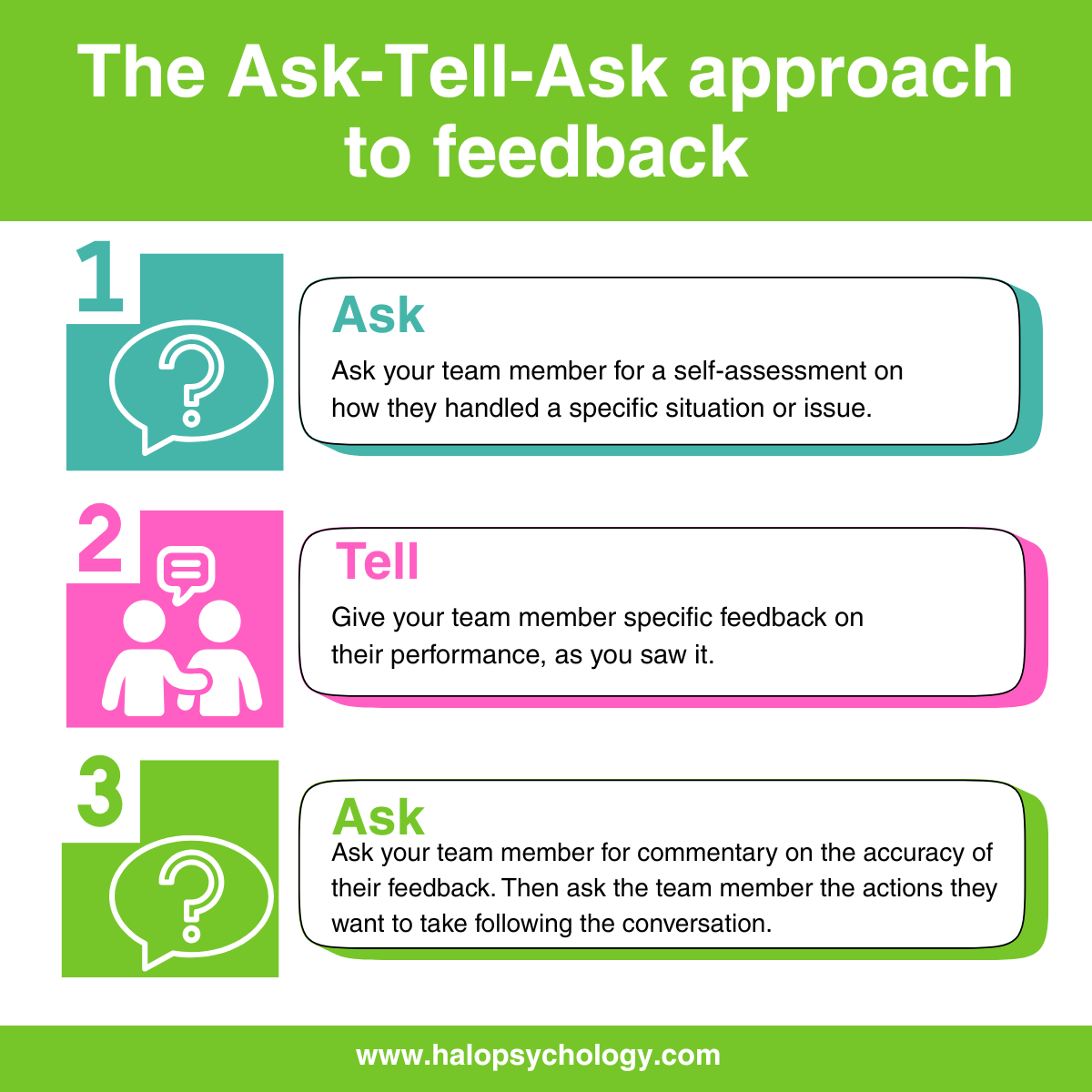
Ask-Tell-Ask (Jug, Jiang & Bean, 2019)
When to use: If you prefer to use a coaching style when giving feedback.
Step 1 (Ask) Ask your team member for a self-assessment on how they handled a specific situation or issue.
Step 2 (Tell) Give your team member specific feedback on their performance, as you saw it.
Step 3 (Ask) Ask your team member for commentary on the accuracy of their feedback. Then ask the team member to specify the actions they want to take following the conversation.

Takeaways on giving better feedback
- Think about the timing of the feedback, particularly if it is negative. Remember, our energy level can impact how feedback givers and receivers handle the feedback. Avoid the end of the workday as most people are likely to be tired.
- Be specific when giving feedback. Give one or two concrete examples but don’t bombard the person with a big list of things. That can end up feeling like an attack. Specific and focused is your aim.
- Remember to be open minded and suspend judgement. You may not have the full story behind why someone behaved or performed in a certain way. Ask questions in a spirit of inquiry, underpinned by compassion. Compassion doesn’t mean letting things go but it can create a more positive environment for the conversation to take place.
- Think about the purpose of the feedback conversation. Is it feedback that needs to be given quickly in a limited time? Is it feedback with a focus on the future? The purpose and outcome you want to achieve will help you pick the most appropriate framework. Remember, one size doesn’t fit all.
Post author: Dr Hayley Lewis. First published on the HALO Psychology website 12 January 2026.
Did you find this post helpful? I’d love to know, either pop a comment below or drop me a note on LinkedIn. If you have any colleagues that you feel should read this, too, please share it with them. I’d really appreciate it.
I also have a monthly newsletter which is a compilation of blog posts, helpful research, and reviews of books and podcasts – all aimed at helping managers and leaders become more confident in handling a range of workplace issues. You can SUBSCRIBE HERE
If you liked this post, you might also like these:
3 tips to help you have a good feedback conversation
How to create a culture where everyone in your team gives feedback
How to have a good annual performance appraisal discussion
REFERENCES
Grant, A. (2021). Think again: The power of knowing what you don’t know. London: WH Allen.
One comment