

It’s May 2025, as I write this, and it’s that time of year again when the annual performance appraisal/review discussions takes place in organisations around the world. And never is there something that elicits as many groans and grumbles as the annual performance appraisal. Managers don’t look forward to it – mainly because its become about filling out lots of paperwork for HR. Team members don’t look forward to it – mainly because it just feels like going through the motions.
This makes me sad because the annual performance appraisal discussion is such a great opportunity to reflect, refocus, and reenergise… when done well.
In this article, I share 11 tried-and-tested tips to help you have a good performance appraisal discussion:
BEFORE THE APPRAISAL DISCUSSION
- No surprises
I’m still surprised (pun intended) at the number of managers I come across who give a team member completely new information and feedback at an annual appraisal meeting. And then they’re surprised (again, pun intended) when the team member is unhappy about this.
The end of year appraisal meeting is never the place to give new feedback – if it is something that could (and should) have been given months previously.
However, if it is something that has come up since the last one-to-one meeting and before the appraisal meeting and is relevant to their job and performance in the job, then raise it. But if it’s something you should have raised a long time ago but didn’t, then don’t go there. Certainly not in a formally documented session, such as performance appraisal, that potentially affects someone’s pay or promotion prospects. Raise it at the next one-to-one after the appraisal.
2. Both parties prepare in advance
If you want your team members to come prepared, send them some questions to reflect on. One of my most popular sketchnotes sets out questions you can ask the person to think about before the meeting. You can also use these questions to help you prepare.

DOWNLOAD THE 10 THINGS TO DISCUSS AT APPRAISAL SKETCHNOTE
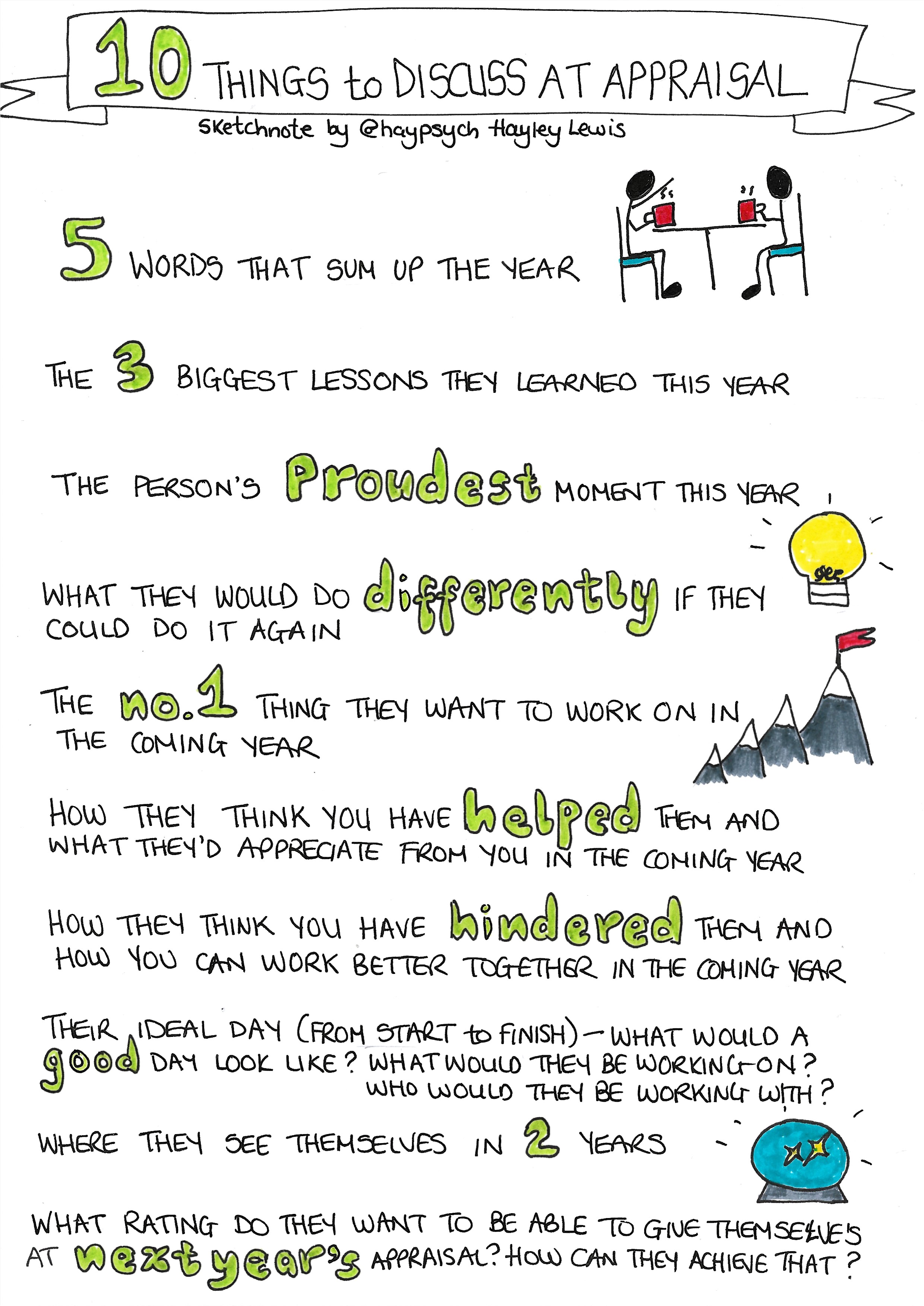
Key things to think about from your perspective as a manager:
- What has the person done well this year? What strengths did you see?
- What hasn’t gone so well? What was the context for things not going well?
- What are the opportunities for the coming year?
- What does the person need to improve?
- What will you commit to doing more of/less of/differently to help them succeed in the coming year?
3. Manage your bias
Our bias as managers can impact how we approach and handle the performance appraisal discussion. For example:
- Are you favouring those whose performance has improved? Some research suggests that we’re more likely to interpret improved performance more favourably than someone who has consistently performed well. In a series of five studies, researchers found that employees who had improved their performance were seen as more deserving of a promotion than those who were consistently strong performers. However, when additional context was provided – such as the difficulties a consistently strong performer had with a customer – managers then saw both the improved performer and the consistent performer as deserving of promotion. Make sure you understand and take into account the circumstances and context each person has been performing in.
- Are you avoiding giving women in your team negative feedback? For example, one study found that women were more likely to be given inaccurate performance feedback. The reason being that managers felt that telling minor lies helped preserve relationships and avoided upsetting or harming the woman.
- Are your judgments about someone’s performance biased by your own cultural or organisational norms? For example, one study found that Black women with natural hairstyles, such as curly afros, braids, or twists, are often perceived as less professional than Black women with straightened hair. This was particularly prevalent in industries with more conservative norms, such as finance, insurance, and government.
- Have you fallen into the trap of the Halo Effect or Horns Effect? Identified by psychologist Edward Thorndike, the Halo Effect refers to the tendency to let a person’s good qualities – or at least those we approve of – colour our perception of their less attractive ones. We’re likely to do this with people similar to us (background, looks etc.) and people we like. The Horns Effect is the opposite – we only focus on the negative things someone does, letting this overshadow or ignore any of the good qualities.
4. Think about the environment
The default has now become online for many one-to-one and performance appraisal discussions. While this might be okay for some team members, it won’t be okay for all. If you want a good discussion, you need to have it in the right environment – one that is conducive to this kind of conversation.
Check with the person whether they want it online, in-person in the office, or outside. For example, Being outside has been associated with greater levels of attention, and higher levels of creativity.
Most appraisal meetings, in my experience, tend to be long – sometimes two or three hours. If running the meeting online, make sure to schedule in some breaks throughout. My suggestion is break it down as 55 minutes discussion followed by 5 minutes screen break, then another 55 minutes and 5 minutes screen break, and so on.
Ensure that both you and the team member are somewhere distraction free. There is nothing that signals how unimportant the person is to you than allowing people to interrupt. Whether that’s your phone pinging throughout, your email alerts going off (particularly if you’re on your laptop for the meeting), or people coming into the room (yes, I have been witness to this!) And when you’re signalling that the person in front of you is not as important as the other things demanding your attention, what do you think is going to happen?
5. Get in the right headspace
As a manager, how you show up and behave sets the tone. Think about the tone you want to set. In her book, Now we’re talking: How to discuss what really matters, Sarah Rozenthuler reminds us,
“The quality of the atmosphere in a room can make or break a difficult conversation and is an essential component of authentic dialogue” (p.46).
Performance appraisal discussions can be long and can go deep. You need to be at your best, not distracted, and 100% focused on the person in front of you. This means being in the right headspace. One suggestion I often make to managers is to bookend a performance appraisal discussion with 10-15 minutes kept free either side. The free time before enables you to get your head in the right place, go back over your prep, settle in. The free time after enables you to decompress, move your body, step away, get a drink – before the next thing in your diary.
When we don’t give ourselves this space, in my experience, this can lead to an unproductive discussion. Particularly if you’re previous meeting runs late and/or has gone badly. If you go straight into the performance appraisal discussion, you’re bringing with you the residue of the previous meeting or interaction. The space allows you to shake it off, as Taylor Swift would say.
DURING THE APPRAISAL DISCUSSION
6. Make it two-way
Key, for a good discussion is for there to be equal airtime. This is where the questions you sent in advance can help. This means the person comes with some of their own points to share. Asking questions during the discussion can help it be two-way.
The purpose of the session isn’t for you to offload the points you want to say to the person, it’s an opportunity for a meaningful, coaching conversation. Asking questions from a genuine spirit of inquiry, curiosity and helpfulness help facilitate a good two-way conversation.
Good quality questions are open, simple, and short. The three-level questioning technique can be helpful:
- Level one questions focus on information/data collection – i.e. what, when, were, how, who?
- Level two questions focus on meaning, implications, feelings, and interest – i.e. what do you feel about…? What does it mean to you? What are the implications of…? What interests you about…?
- Level three questions focus on values and attitudes – i.e. why do you believe that? Why is that important to you? What concerns you about this? Why do you think you reacted that way?
Or we can think about questions as either problem focused or progress focused:
| Problem focused questions | Progress focused questions |
| What happened? | What would you like to see? |
| Who is responsible for this? | How do you feel about this? |
| Why did this happen? | What do you learn from this? |
| Who did this? | What are the options? |
As Dr Nancy Doyle says in her book, Learning from Neurodivergent Leaders,
“When you ask a better quality of question, you get a better quality of answer” (p.211).
7. Give detailed, specific feedback
I posted an Instagram reel a few months ago depicting the confusion that arises when vague, meaningless feedback is given. For example, “You need to be more strategic”, or “You need to be more influential”. In what way? What examples can you give that have led to this being your suggestion? What specific things can you suggest helping the person be more strategic?
Effective feedback essentially answers three questions:
- Feed Up – where am I going? (goals)
- Feed Back – how am I doing? (performance)
- Feed Forward – where to next? (progression)
8. Focus on the future – set clear performance objectives
A clearly articulated, specific and understood goal has the power to purposefully direct action. This is the idea behind Goal Setting Theory which suggests four ways that specific goals help achieve good performance outcomes:
- They direct our attention to what’s important
- They stimulate our effort to focus on what’s important
- They challenge us to use our knowledge and skills so that we’re more likely to succeed
- The more challenging the goal, the more likely it is we’ll draw on our range of skills
A poorly worded performance objective, therefore, might be “Develop a customer service course about handling difficult people”. A better-worded, specific goal might be, “Develop a half-day course about handling difficult customers with first session delivered to 20 call-centre supervisors by 31 March, and evaluation of impact taking place one month later with an evaluation report submitted by 15 May.”
An alternative is to help people define a learning goal. Research suggests that people assigned a learning goal tended to be less tense and perform better, particularly if receiving developmental (negative) feedback. This was compared to those assigned a performance goal who were more tense and performed worse. A performance goal would be something along the lines of “to achieve at least £25k in sales by the end of Q4 – 31st December 2025”. A learning goal has a different intent – for example, “to improve client relationships and bring in new business”. You would then agree some clients to improve relationships with, and what improvements could look like.
And finally, word to the wise. Don’t fall into the trap of setting too many objectives. I’ve come across so many people with 10, 15, sometimes even 20 objectives for the year. This is a sure fire way for someone to feel like a failure. As Professor Robert Sutton says in his book, Good Boss, Bad Boss,
“That’s the problem with holding people, groups of businesses to too many metrics: They can’t satisfy or even think about them all at once, so they end up doing what they want or the one or two things they believe are important or that will bring them rewards (regardless of senior management’s strategic intent)” (p.120).
I suggest no more than five specific goals, and then making clear the order of priority – from most important/critical through to the one that could be sacrificed without penalty, if need be.
9. Engage in deep listening
Truly listening is the ultimate mark of a manager who respects their team members. As Hazel Anderson-Turner says in her book, Coaching through burnout,
“When you give someone your full attention, what you are saying, without needing to say anything is “In this moment, you are the most important thing to me” (p.45).
In fact, one study suggests that an empathetic, non-judgmental, attentive listener may help people feel less anxious and defensive. This, in turn, can encourage people to feel less defensive, explore alternative ideas and differences of opinion.
Julie Starr outlines four types of listening, in The Coaching Manual:
- Cosmetic listening – passive, we look like we’re listening but we’re thinking about something else.
- Conversational listening – also passive, just an exchange, listening to respond
- Active listening – we’re focused on what the other person is saying and giving them our full attention.
- Deep listening – more potent form of active listening, intensely focusing on the words, meanings and patterns expressed in the moment, rather than imagining what we think they’ll say or do next.

DOWNLOAD THE 4 LEVELS OF LISTENING SKETCHNOTE

AFTER THE APPRAISAL DISCUSSION
10. Take some time to reflect
If you’ve been following my work for a while, you’ll know I’m passionate about the benefits of reflective practice for managers. But how many of us take the time to reflect after a performance appraisal discussion? In my experience, once it’s off your to-do list, it’s done, dusted and forgotten.
But it can be helpful as part of your own development to reflect. There are many useful frameworks for you to use. For example, the Henley8 framework, from the book Becoming a Coach: The essential ICF guide, by Jonathan Passmore and Tracy Sinclair. There are eight questions to work through:
- What did I observe?
- What was my response?
- What does this say about me personally?
- What does this tell me about myself as a coach or leader?
- What strengths does this offer?
- What are the potential pitfalls?
- What did I learn?
- What might I do differently next time?
Or you might prefer these questions that I use when helping managers reflect:
- What did I do well? How did I help the discussion?
- What do I need to improve on? How did I hinder the discussion?
- What should I keep on doing in other performance discussions?
- What should I stop doing in other performance discussions?
11. Check-in
24-48 hours after the appraisal discussion, check-in with the person. How are they feeling after the discussion? What resonated? Is there anything they’re confused or uncertain about?
And if you’re feeling particularly courageous – and wanting to set a good example – ask for feedback on how you facilitated the performance appraisal discussion. Not only does feedback help you improve but we also know that what leaders do sends a signal to others about what is and isn’t okay. By asking for, being open to and not defensive to feedback, you’re role-modelling this as good practice for others and they’re more likely to do this themselves.
Post author: Dr Hayley Lewis. First published on the HALO Psychology website 6 May 2025
Did you find this post helpful? I’d love to know, either pop a comment below or drop me a note on LinkedIn. If you have any colleagues that you feel should read this, too, please share it with them. I’d really appreciate it.
I also have a monthly newsletter which is a compilation of blog posts, helpful research, and reviews of books and podcasts – all aimed at helping managers and leaders become more confident in handling a range of workplace issues. You can SUBSCRIBE HERE
If you liked this post, you might also like these:
- 10 things to discuss during performance appraisal
- 3 tips to help you have a good feedback conversation
- 6 things to do when you’ve inherited underperforming or difficult staff
- 5 important skills you need if you manage people
REFERENCES
Owens, B.P., & Hekman, D.R. (2016). How does leader humility influence team performance? Exploring the mechanisms of contagion and collective promotion focus. Academy of Management Journal, 59, 1088-1111.
One comment